I’m a writer, teacher, library advocate, and breast cancer survivor. I live in Southern Oregon, where the mountains are tall, the lakes crystal clear, and the beer hoppy. I’m currently working on a novel set in 17th-century England that involves witches, alchemy, and a wicked-smart crow.
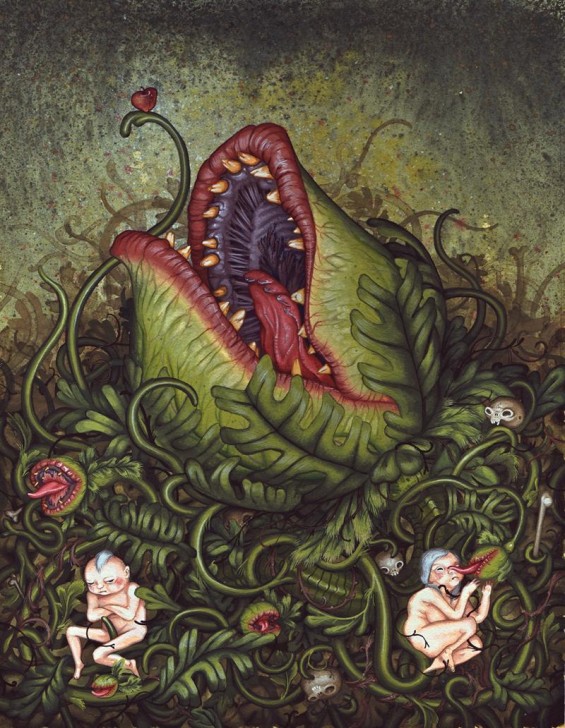
I have a new post up at The Recipes Project about a wickedly beautiful, carnivorous plant and the (mostly useless) cordial that’s made from it: Little Shop of Horrors, Early Modern Style.
Also contains this jaw-droppingly cool artwork by Allison Sommers (check out her other stuff at http://www.allisonsommers.com/)
Painted by Alison Sommers for Gallery 1988’s “Crazy 4 Cult 5.” Image used with permission of the artist.
Treatment for “chincough” or “the kink” might have included medicinals derived from works like this, an 11th-century copy of the “Herbarium of Pseudo-Apuleius” (4th century); Oxford, Bodleian Library, MS Bodley 130, fol. 50v: Lily and Spurge (via Points: The Blog of the Alcohol and Drugs History Society)
(Okay, right off the bat, I’m going to admit that the title of this blog post is link bait. But it worked, right? You’re here? Sorry, “the kink” is probably not what you think it is–keep reading to find out more!)
As a writer/researcher with an interest in the history of science and medicine, I have a hard time listening to anti-vaccination arguments. One only needs to skim the historical record to find gruesome descriptions of childhood diseases like diphtheria, smallpox, and measles to know that vaccinations are one of the great mercies of modern parenting.
This public health threat in my own region must be why, when one of the main characters in my novel-in-progress encounters a deathly pediatric disease, I thought of whooping cough rather than plague or smallpox. My protagonist’s husband,Will, the son of a non-University-trained doctor in the town of Colchester in the 17th century, sees a young mother seeking help for her infant, who has a distinctive, tortured coughing pattern (you can hear an example here). Will listens in horror as his father gives the dreaded diagnosis: chincough.
In the early modern period, whooping cough (pertussis) went by a variety of names: chincough, hooping cough, the kink, kinkcough, kingcough, and quinta were just a few.
An aside: The word “kinkcough” and its variations derive from the obsolete word “kink” (Middle English origins), which meant convulsive fits of laughing or coughing. Helpful hint: Do NOT wonder if this meaning of “kink” is the root of the word “kinky” and then Google it only to realize that your computer is still logged on to your daughter’s Google account—her SCHOOL Google account. Just don’t. (Although when I ‘fessed up to my middle-school daughter, she laughed and said, “Oh please, Mom, it’s just word origins. I see kids at middle school Google worse stuff than that every day.” Gulp.)
“Take mice flea them & cut them in halves take out the entrails and fry them in butter to eat them up.”
In the 18th century, some practitioners evidenced a laissez-faire attitude to whooping cough. In his “Animadversions on a late treatise on the kink-cough” Thomas Kirkland references one “Dr. Willis’s” observation that “old women are oftner consulted in this disorder than physicians,” since, as Kirkland explains, “people seldom apply to physicians, on account of the expence, as they do not apprehend danger, and they know the disease will commonly get well of itself in time.” (This does not, however, stop Kirkland recommending the use of hemlock in every single variation of whooping cough he lists.)
In my novel, we never find out what happens to that young child Will’s father treats, but based on primary sources, there was likely a treatment of purges and nasty medicinals followed by months of horrific fits of coughing like this (warning: upsetting):
And that, my friends, is why my children are vaccinated against pertussis. Now if I could only find a way to protect them from middle school Google searches…
******
Further sources:
Click here for downloadable pdf of Robert Weston’s excellent article on the history of pertussis, “Whooping Cough: A Brief History to the 19th Century.” Canadian Bulletin of Medical History/ Bulletin canadien d’histoire de la médecine / Volume 29:2 2012 / p. 329-349
The Recipes Project is a fascinating site to browse around in. Here’s the description:
“We are an international group of scholars interested in the history of recipes, ranging from magical charms to veterinary remedies. Old recipes can tell us a lot about the past, such as how medicines were prepared, when certain foods became popular, or why ingredients might be magical. Join us as we explore the weird and wonderful world of recipes!”
But it’s not what you think. (God, like I’d ever eat a hedgehog–yikes!)
This hedgehog is a sculpted sort of pudding made from cream, eggs, sugar, almonds, and ambergris. You might be familiar with ambergirs If you’ve read Moby Dick (shout out to anybody who took Mrs. Donohue’s AP English class at Eureka High School in 1988—Go Loggers!). Basically, it’s found in the intestines of whales. ‘Nuff said.
An interesting thing happened to me as a writer as a set out to do research for this post. I realized as I was wading through pages of digitalized 16th- and 17th-century cookbooks that I am starting to think of primary sources differently.
As a scholar, I try to place the material in front of me in the historical, social, religious, and cultural practices of its day.
As a writer of fiction, however, I find myself thinking diachronically, trying to see the threads that link another time with ours, to suss out the kinds of issues, obsessions, worries, and joys that we share in common with other cultures and times.
I noticed this first as I was paging (electronically) through the recipe book of Lady Anne Fanshawe (1625-80), the wife of the ambassador to Spain. Like other “receipt books” (what cookbooks and recipe books were often called in the early modern period), this was an ecletic collection—some might even say a mish-mash—of recipes for food, medicine, perfumes, and cleaning supplies.
As I read through these recipes, I marveled at how much the recipe book reflected what likely went on in the early modern kitchen. Unlike modern cookbooks, which present an idealized, airbrushed version of reality, with precise measurements, reliable outcomes, and mouthwatering pictures, this recipe book was a working document, with cross-outs, amendations, and commentary.
And unlike modern kitchens, which seem to be exclusively dedicated to the preparation of food and drink (and the occasional batch of playdough), the early modern kitchen was the site of all kinds of cookery: coction, distillation, presentation of food, medicine, and whatever else needed transformation by fire.
Despite these differences–differences that should have made me feel alienated or at least distanced from the text–I felt something tugging at me, some sense of connection to the seeming chaos of this recipe book.
I flashed on a scene from one of my favorite books as a kid, A Wrinkle in Time by Madeline L’Engle. Meg is home after a miserable day at school, sitting in the cozy kitchen, sharing her worries with her scientist mother. Mrs. Murry, who is making hot cocoa for her on the Bunsen burner.
The only problem with the scene as I’ve described it is that it doesn’t exist. I just looked it up, and it is Meg’s precocious little brother, Charles Wallace, who makes the cocoa for Meg and Mrs. Murry, and the Bunsen burner is in a lab by the back door.
I find it interesting, though, that my younger self conflated the two kinds of cookery: culinary and scientific. There’s a thread that runs between the recipe book of Lady Anne Fanshawe and my memory of that scene in A Wrinkle in Time: the multiple roles women are expected to fill. Mother. Healer. Chef. And, sometimes, scholar.
That Bunsen burner became for me, I think, emblematic of what I felt least comfortable about in this beloved book: Mrs. Murry may have been a scientist, but she was still responsible for the kids, holding down the house, and cooking the food. And while Meg’s father was gallivanting across time and space, Mrs. Murry was signing field-trip permission slips and making phone calls for the PTA while studying tesseracts and mitochondria.
As a scholar, the fact that the scene as I remembered it doesn’t exist would destroy whatever literary argument I was making. As a writer of fiction, the awareness that I had embellished on the scene, molded and shaped it until it reflected my own concerns, provides me with rich fodder for the imagination.
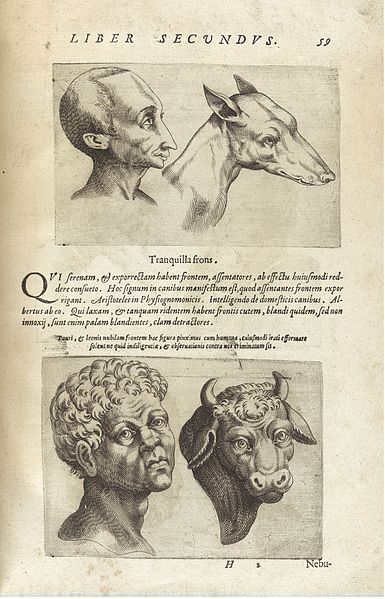
We’ve all heard the theory that people look like their pets (or is it vice versa?), and we’ve all seen the uncanny photos, like these featured in the popular listicle website, Buzzfeed (oh dear, number 23…)
(As an aside: I joke that it’s because of this resemblance theory that I adopted a greyhound—it was a weight-loss strategy. And no, it didn’t work.)
Illustration from De humana physiognomonia libri IIII, Wikimedia Commons
This fascination with resemblances between people and animals is nothing new, as we can see in Giambattista della Porta’s De humana physiognomonia libri IIII(1586)
Illustration from De humana physiognomonia libri IIII, Wikimedia Commons
Della Porta (also known as Giovanni Battista Della Porta and John Baptist Porta) (1535-1615) was a scholar and philosopher from Naples, most famous for his work in magic, mathematics, and natural philosophy (among many other things—he was quite the polymath).
Della Porta founded the Accademia dei Segretti (Academy of Secrets), one of the first of the early secret societies devoted to studying natural philosophy and discovering “the secrets of Nature.” These natural secrets were often thought to be perilously close to occult secrets, and della Porta was summoned to Rome by Pope Paul V to answer for rumors that the Academy had too keen an interest in magic. He was found to be innocent, but the Academy was shut down by the Inquisition.
Della Porta would later go on to co-found the Accademia dei Lincei, the Academy of the Lynxes (or Academy of the Lynx-Eyed: the lynx, thought to have extraordinary vision, symbolized the critical importance of observation in the “new science.”) A similar institution in England, the Invisible College, would eventually morph into the Royal Academy of Sciences.
Della Porta’s text was influential in the ancient pseudoscience of physiognomy, the study of determining a person’s inner character by her or his outward appearance. For della Porta, this analogous thinking was a product of the doctrine of signatures, the theory that medicinal plants would look like the part of the body they could cure (hence roots like the phallic-looking mandrake were thought to help impotence and fertility). While it may seem strange to modern thinking, terms from physiognomy are common in our daily lexicon. It is from physiognomy, for example, that we get the terms “highbrow” and “lowbrow.”
The impulse to judge a person’s inner qualities by their outward appearances is ancient, but the categorization and codification of these aesthetic judgments is relatively modern. In the 18th and 19th century, together with its cousin phrenology, physiognomy enabled pernicious forms of scientific racism.
Strangely enough, physiognomy is making a bit of a comeback, albeit in a modified form. Scientists have taken to studying people’s reaction to different kinds of faces, as profiled in this Economist article . Whether this kind of study is helpful or not is debatable: do these studies counter or reinforce stereotypes when they assert, for example, that men with angular faces are perceived as criminal? That attractive men have an evolutionary advantage because their faces cause women to orgasm more frequently? When a generalized theory is applied to the individual, does it simply slip into stereotype?
***
Completely gratuitous additional note about the greyhound thing: if you were to judge my character (and not my body habitus), the greyhound would actually be an appropriate choice for analogy, as it comes in at #8 on this list of “Top 10 Dogs for Lazy Owners”!)
More information on Giambattista della Porta and/or physiognomy:
I recently returned from a trip to the UK, and between cathedrals and castles and museums, I worried my jaw would freeze from all of the gawping.
And I wondered: do most Americans feel a bit “Hee-Haw” when traveling?
Exacerbating this feeling is that I’m a dyed-in-the-wool American West Coaster. I grew up in the wilds of Northern California (think redwood trees and Bigfoot, not San Francisco and cabernet) and now live in the wilds of Southern Oregon (think Crater Lake and blue collar, not Portland and Blue Moon beer).
My husband and I lived in Philadelphia for five years, and even though I had been to Europe before, I still remember the reverence with which I trod the cobblestone streets, stood at the epicenter of William Penn’s “greene country towne,” and threw a penny on Benjamin Franklin’s grave (sidestepping the three singing Benjamin Franklin impersonators to do so). When my husband and I accidentally stumbled on the building housing the Liberty Bell (much easier to do in the 90s before its new digs were built), we stared at each other in awe. “Do you suppose that’s the LIBERTY BELL bell? Like, the real one?” I whispered.
One year when my parents were visiting, we took them on a tour of Independence Hall. The eager young tour guide (think Kenneth from 30 Rock about ten years younger) marveled at the cumulative history of the place. “This building is over TWO HUNDRED years old! How many of you have been in a building that’s over TWO HUNDRED years old?”
A good three-quarters of the room raised their hands. The tour guide blushed
I remembered this episode while walking through Westminster Abbey, the Tower of London, Christ Church College, the Bodleian, Cardiff Castle, and Trinity College Dublin.
It came back with special force when visiting the Bodleian’s exhibit “Magical Books.” I knew I was going to see a First Folio Macbeth. John Dee’s Holy Table. C.S. Lewis’s map of Narnia. I was prepared for all these, but even so there was an element of unreality to it all. “Is that the FIRST FOLIO MACBETH Macbeth? Like, the real one?” I whispered in my best Beverly Hillbillies drawl.
Then there were the surprises. I had no idea that the exhibition would prominently display one of the Ripley Scrolls. I walked into the smallish room housing these treasures and one of the first things I saw was the splashy toad of the Ripley Scroll prominently splayed out, the reds and greens and golds of the scroll still brilliant after all these centuries.
There’s so much here, I don’t even know where to begin. I won’t be able to write a coherent sort of essay right now about the Ripley Scrolls, as I’m just now wrapping my head around their magnificence.
There are 23 copies of the Ripley Scrolls, which get their name from the 15th-century alchemist George Ripley, as snippets of his verses are included on some of the scrolls. Most are thought to have been copied in the 16th and 17th centuries from a now-lost original.
The scrolls depict–in what to modern eyes are bizarre and obscure symbols–the process of making the Philosopher’s Stone, the substance thought to impart eternal life and to contain the power to turn base metals into gold.
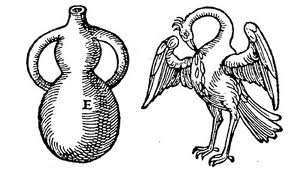
I’m particularly interested in the “pelican flask,” the apparatus the alchemist is holding in the first panel. The pelican was a vessel that allowed the distillation of substances in the alchemical process to occur in a closed system. The shape of the vessel was reminiscent of the fable of the pelican, which was thought to pierce its own breast in order to feed her young from her own blood (and which, in Christian symbolism, represented Christ’s blood sacrifice). The resemblance can be seen here:
Alchemical pelican, Wikimedia commons
The pelican the alchemist is holding is cut away to reveal the changes the substances are undergoing–but despite the seeming transparency of the cut-away pelican, the changes are cloaked in the arcane system of symbols and riddles that marks the pursuit of alchemy (as you can see below).
By George Ripley [Public domain], via Wikimedia Commons
Here’s a great video made by the Beinecke Rare Book and Manuscript Library at Yale University:
My next step is to get a better digital copy of this manuscript (as an aside–the digital availability of archival material is the best thing to happen since the Big Bang). I want to check out what’s going on in the pelican, especially with that weird toad. I’m thinking this more descriptive video from Adam McLean, who has been writing about alchemy for decades, may also be helpful:
Next post: toads, green lions, and menstruating dragons…
As I sit here unable to sleep at 3:00 in the morning, my Twitter feed is filling up with breathless (and often snarky) observations about the royal baby. Helicopters hover over St. Mary’s Hospital in London. The BBC has cameras aimed at the front door of the hospital. Media experts are yammering on about how—with Twitter and RSS feeds—this is the most observed royal birth ever (ya think?).
#RoyalBaby is trending. Pundits debate whether Kate will have a C-section: “too posh to push?” as I read on Twitter. The Queen wonders out loud about whether she’ll have to postpone her holiday.
With all of this hoopla and manufactured drama, I can’t help but think about another royal birth that figures in the novel I’m writing: that of Henrietta Anne, born to King Charles I and Queen Henrietta Maria under very different circumstances.
Henrietta Maria, by van Dyck
Queen Henrietta Maria became pregnant after an emotional reunion with Charles in Oxford, where he’d found refuge during the First Civil War. The Queen was an experienced mother, having given birth to eight children already, but this was a difficult pregnancy. The Queen was convinced the time of birth was coming soon (though in fact it was still months away), and she was diagnosed with “fits of the mother,” bouts of hysteria thought to be caused by her laden womb.
After the Royalist loss at the Battle of Alresford, the Queen felt both ill and insecure. She convinced Charles to let her take the waters at Bath. On April 17, 1644, Charles accompanied Henrietta Maria to Abingdon to say their goodbyes. He returned to Oxford, and she departed for Bath.
It was the last time they would ever see each other.
Bath was a disaster: plague-ridden, with corpses left to rot in the street. The Queen continued on to Exeter, where she could take refuge with friends while awaiting her labor.
She was ill. Very ill.
Her usual doctor, Sir Theodore Mayerne, who had never liked the Queen, refused to come and tend to her, only relenting when the King himself sent a note reading, “Mayerne, for the love of me, go to my wife.” When the Queen confessed her fear that her illness was making her crazy, Mayerne responded, “You need not fear it madam, for you are that already.”
With friends like these . . .
The Queen finally gave birth on June 16, 1644, more than two months after she told the King she was certainly going into labor very soon. The birth was a difficult one that left her partially paralyzed and temporarily blinded, and she confessed that she often wished for death.
But Henrietta Maria did not have time for death.
The Earl of Essex’s Parliamentarian army was approaching Exeter, and Henrietta Maria had to flee. Just two weeks after giving birth to baby Henrietta Anne, she was forced to leave her with friends and servants as she fled with her confessor and a small handful of trusted advisors.
Almost immediately, they encountered Parliament’s forces. Henrietta Maria was forced to hide under a pile of rags in a small cottage for two days with no food and no water, uttering no sound. The soldiers were so close, she would later tell one of her ladies-in-waiting, that she heard them name a reward of fifty thousand crowns for anyone who captured her.
A week later, on June 29, 1644, Henrietta Maria arrived at the relative safety of Pendennis Castle in Cornwall and shortly fled England, Essex’s troops in pursuit, for her homeland of France.
Henrietta Maria would not see Henrietta Anne until June 1646.
Princess Henrietta Anne, Duchess of Orleans, by Pierre Mignard
Sources:
A Royal Passion: The Turbulent Marriage of King Charles I of England and Henrietta Maria of France, Katie Whitaker
Mad Madge, Katie Whitaker
Lord Minimus: The Extraordinary Life of Britain’s Smallest Man, Nick Page (a biography of “the Queen’s Dwarf,” Jeffrey Hudson)
Probably it’s a combination of the two: a realization that, had I lived in 17th-century England, the presence of a doll’s head in my yard would have had me tied to the stake before I could say “NOT MY POPPET!” That’s why my nomination for Vile-Hearted Renaissance Peckerhead of the Month is Matthew Hopkins, the self-styled “Witchfinder General,” thought to be responsible for the deaths of over 300 women (and some men).
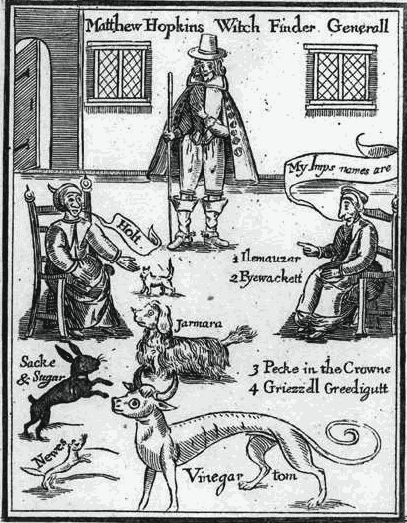
Matthew Hopkins, “Witchfinder General”
Hopkins was an innkeeper in the village of Manningtree, across the River Stour from Colchester. According to his own book The Discovery of Witches, composed in question-and-answer form, Hopkins came to witch-hunting after overhearing some women discuss meeting with the Devil in the woods outside of Manningtree:
The Discoverer [Hopkins writes about himself in the third person here] never travelled far for it [experience in witch finding], but in March 1644 he had some seven or eight of that horrible sect of Witches living in the Towne where he lived, a Towne in Essex called Maningtree, with divers other adjacent Witches of other towns, who every six weeks in the night (being alwayes on the Friday night) had their meeting close by his house and had their severall solemne sacrifices there offered to the Devill…
Hopkins claims they mentioned the name of another witch, so he told the authorities and had her apprehended. She was examined “by women who had for many yeares knowne the Devills marks.” She was found to possess the traditional mark of the witch: a third teat, a nipple from which she was thought to suckle her familiar, or “imp.”
As an aside: Supernumerary nipples, often called third nipples, are very common, occurring in about 1 in 18 people: Entry on supernumerary nipples from Medline. They may not be interesting medically, but they sure are culturally:
(Video of Bradley Cooper pranking Ellen Degeneres by showing a third–and fourth, and fifth–nipple.)
After finding this damning evidence of the woman’s pact with the Devil, Hopkins and his associates forced her to stay awake for three nights altogether; on the fourth night, says Hopkins, she surrendered and called five of her imps:
1. Holt, who came in like a white kitling.
2. Jarmara, who came in like a fat Spaniel without any legs at all, she said she kept him fat, for she clapt her hand on her belly and said he suckt good blood from her body.
3. Vinegar Tom, who was like a long-legg’d Greyhound, with an head like an Oxe, with a long taile and broad eyes, who when this discoverer spoke to, and bade him goe to the place provided for him and his Angels, immediately transformed himselfe into the shape of a child of foure yeeres old without a head, and gave halfe a dozen turnes about the house, and vanished at the doore.
4. Sack and Sugar, like a black Rabbet.
5. Newes, like a Polcat.
After this parade of familiars, the woman “confessed severall other Witches” and told Hopkins where to find their “marks” (third teats) and the names of their imps “as Elemanzer, Pyewacket, Peckin the Crown, Grizzel, Greedigut, &c. which no mortall could invent.”
As a result of Hopkins’s investigation, 23 women were tried in Chelmsford; nineteen were hanged and four died in prison.
This success launched a new career for Hopkins. He hired an assistant, John Stearne, and a group of women who examined the accused witches looking for their “witch’s mark” (often, if they couldn’t find a likely third teat in the form of a mole or birthmark, they would prick the woman’s flesh attempting to find one—in effect creating the very mark they were looking for).
Hopkins and his methods were startlingly popular. Torture was illegal, but Hopkins had other ways of extracting “confessions,” the most famous of which was a swimming test. The theory was that since witches had renounced their baptism, water itself would reject them. The suspected witch was tied to a chair and thrown into a lake or river. If she floated, it was a sure sign of her witchiness. If she sunk, she was innocent. Either way, she would likely die.
Though Hopkins was generally successful in his career (Ipswich residents even levied a tax to pay for his services), he was not without enemies. The most effective of these was the vicar of Great Staughton, John Gaule, who, though he acknowledged the existence of witches, deplored the folkloric roots of Hopkins’s methods for gathering evidence. He was particularly opposed to the swimming test, and he successfully lobbied for tougher evidentiary standards in the publication Select Cases of Conscience touching Witches and Witchcrafts.
Hopkins published his work The Discovery of Witchesin 1647, in response to Gaule, and its influence was great in the new American colonies. His own witch-finding career, however, was not to survive as long as his influence: he died shortly after the publication of his work in August 1647.
Though Hopkins probably died of natural causes, a tale of karmic justice has grown up around his death: popular local history held that he himself was tried as a witch and died as a result of his own creation, the swimming test.







 Jennifer Sherman Roberts