We’re A Nation Of Cowards

pexels-photo.jpg


Original Post:

About two weeks ago, my husband and I were casually chatting with our daughter. Out of the blue, she said, “Mom, you know how sometimes I hug you for an extra-long time in the morning and kind of seem like I don’t want to go to school? That’s because I’m wondering if today’s the day there will be a shooter in my classroom.”

She told me she and her best friend even have a bucket list, just in case they get shot at school.

She’s 12.

About a week later, on Friday, October 1, 2015, a gunman killed nine people and wounded nine others at Umpqua Community College, about 70 miles from where we live.

On Monday, a bomb and shooting threat was received at Rogue Community College, in our town. The campus was shut down and schools in our county were either locked-in or had extra police officers.

Last night, a note containing unspecified threats was found at Southern Oregon University, about 40 miles from us, prompting officials to close the campus.

I just don’t know what to say. Over the last few days, in person and on Facebook, I’ve had conversations with those who (like me) favor gun control and with those who don’t.

Those who would like to see more regulations are frustrated. We keep having the same conversations: why not? Why not put commonsense gun laws in place?

Those who oppose gun regulations are also frustrated. Our conversations go something like this:

I say there are too many guns. They parrot Wayne LaPierre of the NRA and say the only way to stop a bad guy with a gun is a good guy with a gun. (Ignoring that the police can’t possibly tell the difference between the two when entering an active shooter situation.)

I say we need better gun laws. They say that won’t work because criminals don’t obey laws. (Ignoring the obvious slippery slope—if the lawless won’t obey laws, why do we have laws about theft, or murder, or drunk driving?)

They say we don’t need gun control, we need mental health. I nod and say, okay, let’s have better mental health.

I say over 90% of Americans agree we need better background checks for gun purchases. They say that it’s a slippery slope to abolishing the second amendment.

The same conversation. Each time.

And now I feel like a massive raw nerve, shaking with anger and confusion and fear.

I want to kick and scream and yell into the universe, “WHY? WHY NOT AT LEAST START SOMEWHERE?”

Why can’t we start having better background checks? Start improving mental health access? Embrace logic and reason and empathy when we’re discussing guns and gun control? At least start and see if it works. See if we end up with fewer dead kids.

The sad, disillusioned core of me knows the answer. We can’t do these things because of the NRA.

The NRA has carefully crafted an environment of paranoia that makes people think  having armed teachers in the classroom is a viable solution to gun deaths.

The NRA has purchased enough elected representatives that Congress recently extended a ban on research to even find out what forms of gun control work best.

The NRA has created a dystopian society in which it can produce a cartoon for kids, warning them to stay away from all of the guns lying around. You know, because it’s the grown-ups’ constitutional right to leave guns lying around.

And gun manufacturers just keep churning out more guns, more profits, more death.

I want to yell and scream and shout and holler, but I’m scared nobody will listen. Because I’m just a mom. Everybody expects parents to get all hysterical about their babies being in danger. It’s not like I’m a politician or a lobbyist or somebody important.

To be honest, writing this scares me. I’m afraid of voicing my opinions. I’m afraid of the scorn and ridicule of even my own friends and family, those people I love but disagree with.

But we’re a nation of cowards. America has been afraid of the NRA and gun manufacturers for too long. We need to demand accountability from our politicians. We need common-sense gun control, and we need research and respectful debate about how to balance constitutional rights with the rights of our children to grow and thrive in safety.

What kind of world do we live in that we can even think about debating whether a teacher should have a gun in the classroom? In which Congress would actually BAN research on reducing gun deaths? In which 5-year-olds regularly have “dangerous intruder” drills? This is complete fucking insanity.

I just don’t know what to do or say to my kids. We’ve left them such a mess.


Another Update, 5/18/18:

This time it was in Santa Fe, Texas. 10 dead.

Another Update 2/14/2018:
This afternoon, a shooter (again, I won’t say his name) killed 17 people and wounded numerous others in Parkland, Florida. I’m so afraid. Not just of shooters and bullets and seeing the bodies of my dead children, but afraid that as a society we’re growing numb, that we have no problem thinking about the unthinkable.

My friend Jennifer J. has an idea. What if we keep our kids home from school until SOMETHING is done? I propose that “something” be doing away with the Dickey Amendment, which threatens to defund the CDC if it funds research on gun violence (even Jay Dickey, eponymous sponsor of the amendment, changed his mind about it, saying “We need to turn this over to science and take it away from politics”).

This could be a walk-out. Or a one-week strike. Or longer. Perhaps we could wait until the bell rings and then pull them out one minute for every student who lost their lives today? (Thanks to Ann S. for that idea that preserves school funding.)

Can we change things? Can we live with ourselves if we don’t try?

(And please, if you don’t like this idea, call your representatives, join an effective advocacy group, or write a letter to the editor.)

***

Update (September 14,2016)
Early this morning, in a nightclub in Orlando called Pulse, a shooter (I won’t say his name) killed 50 people and wounded 53. The shooter’s father said the shooter became enraged when he saw two men kissing on the street.

This is the worst mass shooting (in terms of numbers of dead) in US history. The shooter used an AR-15, a type of assault rifle also used in Newtown and Aurora. We do not know how to keep this type of weapon out of the wrong hands, however, as Congress has rejected an amendment that would have repealed a ban on conducting research into the causes of the gun violence epidemic.

We need to act. We need to hold our elected officials accountable. We need policy, not just prayers.

Here is a link from the Huffington Post on contacting your representatives: “An Easy Guide to Contacting Your Elected Representative About Gun Control.”

***


Trolling Librarians Are The Best Librarians

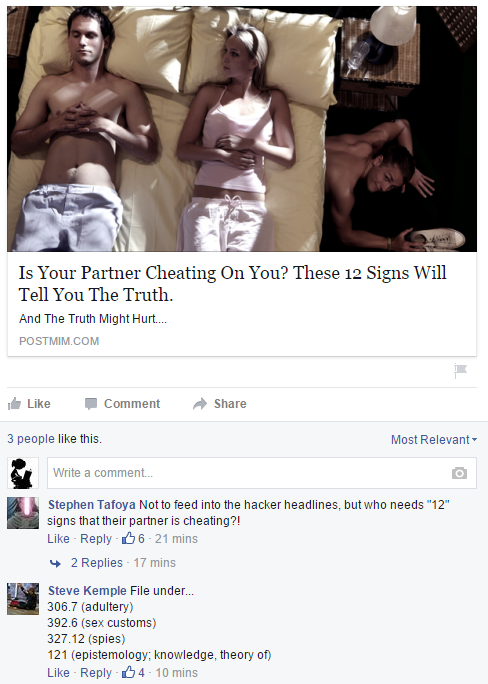
Hacking’s a terrible thing. Terrible.

Except when it isn’t. Like when this guy pretended to be a Target sales rep and trolled people opposed to Target’s new gender-neutral toy marketing policy.

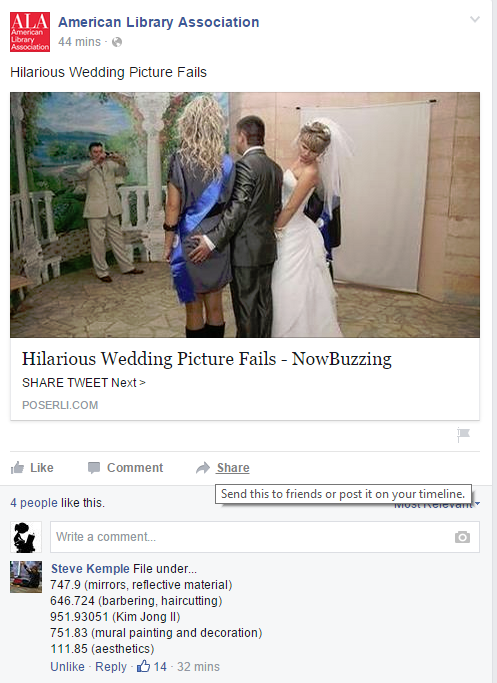
Or like when the American Library Association got its Facebook account hacked a few hours ago and librarians got all funny and beautifully weird and trolled the hackers, like in the screen shots I captured below.

Did I mention I freaking love librarian humor? These people are the salt of the earth.

ala2

Librarians are very discreet:

ALA3

Did you know your library records are always kept private?:

ALA5

Librarians can guide you to examples of words like “misogyny” (ya know, if you’re a visual learner):

ALA7

No, but really, some good advice from Stephen and Steve here:

ALA6

Libraries Matter, No Matter What

A young JCLI volunteer (my daughter!) protesting the library's closure.
A young JCLI volunteer (my daughter!) protesting the library’s closure.

In May 2007, all four branches of the library in Josephine County were closed due to lack of funding. More than 82,000 people were left without access to any library whatsoever.

(Over eight years later, I still feel a little shocked writing that.)

A past library levy had been absorbed into the county’s general fund. When the federal government failed to renew a decades-old subsidy (meant to reimburse county governments for the loss of income from logging on federal lands) and voters (mistrustful of county government) failed to pass a measure establishing an independent library district, the libraries were closed.

I was there, and I was devastated. I kept thinking about how a whole generation of kids would grow up receiving the message–from their own community–that books, literacy, and knowledge don’t matter. That learning about the world outside their borders doesn’t matter. That libraries don’t matter.

In August 2007, a group of concerned citizens banded together to form Josephine Community Libraries, Inc. (JCLI), and after 18 months of fundraising—stuffing envelopes, staffing information tables, and begging councilors and commissioners for money—volunteers reopened the Grants Pass branch of the library. Committed to providing library services throughout the county, the board of directors made it a priority to reopen the other three rural branches as soon as possible after the opening of the main branch.

I’ll never forget the opening of the Children’s Room on that cold December day in 2008. I was standing at the circulation desk so I could take pictures. On the other side of the ceremonial ribbon stood crowds of excited and curious kids. When the ribbon was cut, the kids streamed into the room. When it came time to check out, they had stacks of books in their arms and magic in their eyes.

On that day, we sent a message to the kids in our community: we care. We care about their education and imagination. We care that they have a future in the larger world.

Last fall, citizens placed a library district on the ballot in Josephine County that would have provided long-term, sustainable funding for libraries in Josephine County. Sadly, it didn’t pass. If it had, renovating the Children’s Room would have been one of the first priorities.

However, despite our disappointment in the results of the election, JCLI remains determined to provide quality library access for the children in our community by launching First Chapters, a project to modernize and enhance the Children’s Libraries in Grants Pass and Cave Junction.

The project will fund updated books, mobile bookshelves kids can reach, and furniture that actually fits them. It will provide technology that matches their need to learn and resources that fit their need to play.

Just one of the many books that needs replacing.

JCLI has also partnered with Oregon’s Kitchen Table, a group of non-partisan, non-profit community organizations that is helping JCLI with crowdfunding, so that as many people as possible can donate to the project, to feel ownership of the amazing work libraries are doing in our community. If you’d like to help out, you can make a donation here.

First Chapters

By reopening the libraries, we transformed the message we were sending to our kids. Instead of telling them that books, knowledge, and culture are expendable, we taught them the importance of lifelong learning and connection with community and the outside world. With First Chapters, we can reinforce that message. We can teach them that libraries matter, no matter what.

Wigging Out: Mrs. Corlyon’s Method for Extracting Earwigs From The Ear

So I wrote this post for The Recipes Project to answer the perennial question “What do John Donne and Taylor Swift have in common?”

(Spoiler #1: no I didn’t–it just worked out that way)

(Spoiler #2: earwigs)

Wigging Out: Mrs. Corlyon’s Method for Extracting Earwigs From The Ear


Earwig_Dermaptera_unidentified_2014_04_06_5259

Laughing at History

By Netherlandish (possibly Jacob Cornelisz. van Oostsanen) [Public domain], via Wikimedia Commons
Yesterday the website The Mary Sue published a post of mine, a short, lighthearted little thing about the malady known as green sickness.

After it was published, I committed the cardinal internet sin of reading the comments. Normally I don’t do that, but The Mary Sue’s readers are savvy and smart, and I was curious what they said.

Most comments were written in the same vein as the post—funny, a little snarky, lighthearted. But one comment made me pause. In a nutshell, it asked “Why is this something to laugh at? Surely this was a real problem for some people.”

It’s a compelling point and one worth bearing in mind, always. When we laugh at things from the past, are we demeaning the lived experience of real people?

I hope I would never do that. I did, however, want to poke fun at a system of beliefs about women that reduced them to uterine function. The theory behind green sickness was that a virgin was vulnerable to all sorts of maladies because the ultimate function of the uterus was to be occupied, either by a man’s seed or by a child, and until that happened, it was a site of blocked humors and disease that made a maiden sick, weak, and listless.

It’s the same system that attributed a host of physical and mental disorders to a woman’s “wandering womb.”

It’s crucial we remember the role that set of beliefs played in the history of medicine, how it served as a foundation for the ways we think about and discuss women’s health.

It informs the social structure that allows Todd Aiken to mystify reproductive biology and argue the rarity of child conceived in a “legitimate rape” because “the female body has ways to try to shut that whole thing down.” 

That system still shapes the way we talk about menstruation and menopause, even about PMS.

Every day I read news stories that sound like they come right out of Margaret Atwood’s A Handmaid’s Tale. Women’s reproductive rights are being eroded day by day, from mandatory transvaginal ultrasounds to the limits on abortion even in the cases of rape or health of the mother.

And for a chilling analysis of how the past seems to repeat itself when it comes to the regulation of women’s wombs, read this piercing analysis by Margaret Lewis of the similarities between 17th-century infanticide trials and the 20-year sentence given to Purvi Patel. (Especially shocking is the use of the “lung test,” which has been recognized as scientifically flawed for the last 200 years.)

We need to remind ourselves of that system that used biology to define women, by their very nature, as weak, helpless, and incapable of decision or action without a man’s help.

I deeply appreciate that commentor’s reminder that there are real people behind these stories and diagnoses and treatments. It’s something I hope never to forget.

But I don’t think I can stop laughing at the ridiculousness of a system that reduces women to one particular organ. Because if I don’t laugh, I’ll cry.

The Spitting Image

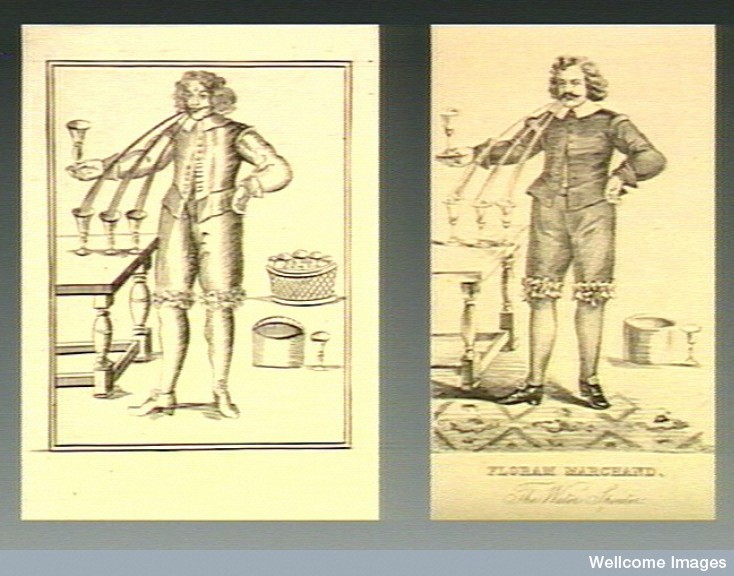
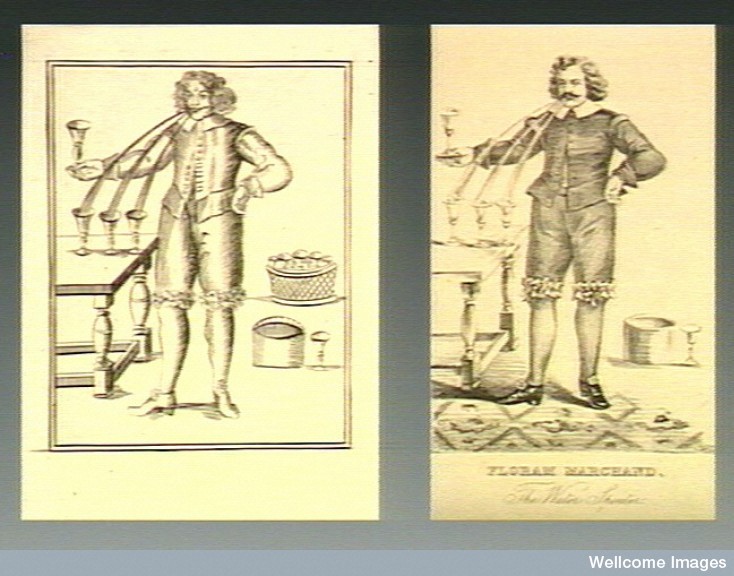
Floram Marchand, a man who regurgitated water transformed into several colours and into separate vessels. Reproduction of a stipple engraving. Wellcome Library, London
Floram Marchand, a man who regurgitated water
transformed into several colours and into
separate vessels. Reproduction of a stipple
engraving. Wellcome Library, London

I came across this image while browsing in the online collection of the Wellcome Library (heaven only knows what my search terms were). Even in the often-bizarre world of the Wellcome’s collection, with wood engravings of eyes swollen shut by a witch’s curse and pictures of possessed men spitting up nails, this image stood out.

Regurgitating, spitting, expectorating—it all gets a pretty bad rap. About the only time it’s marginally socially acceptable is when done by cute babies. (Witness the time one of my daughters (in the interest of familial harmony, I won’t identify which one), age 12 months, spit up on her grandfather just as my camera was clicking to take their picture. I now have a permanent record of the look of satisfaction on her face and the blend of surprise, disgust, and great good humor on his.)

In the 16th and 17th centuries, however, some performers were able to take the act of regurgitation to a whole new level.

V0007186 Biagio di Manfrè, who regurgitated water transformed into ot
Though this image has Floram Marchand’s name, the Wellcome Library identifies this as Blaise Manfred (Biagio di Manfrè). Engraving after Wenceslaus Hollar. Wellcome Library, London.

Popular entertainer Blaise Manfrede was known for his ability to seemingly transform the vast amounts of water he swallowed into other liquids like milk or wine.   His student, Floram Marchande, the subject of the above engraving, was known for turning water into a variety of wines, each in its own arc spit high above the crowds.

V0007188 Floram Marchand, a man who regurgitated
Floram Marchand, a man who regurgitated water transformed into several colours and into separate vessels. Reproduction of a stipple engraving. Wellcome Library, London

According to Joe Mitchell in Secrets of the Sideshows, Manfrede and Marchande employed special mouthpieces to help them spit the water in such dramatic fashion, and as for turning the water into wine—given that the “wine” got paler and paler the longer the act went on, it’s likely that Marchand ingested a red dye made from brazil nuts beforehand.

Though perhaps not as popular as it once was, the art of regurgitation has never really been abandoned. For example, in the 1920s and 30s, a Vaudeville performer named Hadji Ali was famous for swallowing and regurgitating water, nuts, smoke, handkerchiefs, and kerosene (which he would then spit out on a lit fire). You can see highlights of his act here:

Continuing the regurgitation tradition (if that can be said to be a thing), Glasgow-born Stevie Starr has made a career of regurgitating all sorts of items: broken glass, balloons, goldfish, and dry sugar. In 2010, he appeared on Britain’s Got Talent and flummoxed the audience by swallowing Amanda’s ring, a key, and a lock, and the regurgitating the ring—which was hooked onto the lock, presumably while in his stomach. Here it is (and oh my god, Amanda, are you really going to let the symbol of your enduring love be regurgitated by that man? Really, Amanda?):

Honestly, it’s enough to give a gal heartburn.

Scratching “The Itch Infalable” at The Recipes Project

I wrote this blog post for The Recipes Project: Food, Magic, Art, Science, and Medicine about a 17th-century anti-itching recipe: Scratching “The Itch Infalable”: Johanna St. John’s Anti-Itch Cure

On the downside, you may get psychosomatic itching after reading it, much like in 5th grade when you watched all those educational movies about lice. On the plus side, there is a largely gratuitous picture of an adorable scratching cat.

I Am Not My Writing

Stipula_fountain_pen
“Power of Words,” Antonio Litterio. Wikimedia Commons

I’m currently revising a novel in which some folks have said I do a whole lot of telling and not enough showing.

I trained as an academic, so it’s practically a given that my early fiction attempts would skew towards the didactic, the wordy, the analytic. I knew that going in.

So if that feedback is so straightforward, why am I struggling with feelings of embarrassment, even shame? (And now we enter Inception-level neuroticism, in which I’m a little embarrassed about feeling shame.)

All I really have to do is add some more dialogue, inject more ambiguity in my characters by showing actions rather than explicating motives.

But when I sit down to do so, when I open the file and look and what I’ve written, when I revisit the feedback I’ve gotten, I’m embarrassed that I didn’t see these issues before.

Why do we writers do this to ourselves?

When I teach writing, I hammer the idea that writing is a skill, a techne, that improves with practice and feedback. I also insist my students share the following assumption: a critique of someone’s writing is not a critique of that person. I can object to a vague thesis or point out a comma splice and still think the writer is good and smart and worthwhile.

By the end of the quarter, my students can recite my mantra with me: “I am not my writing.”

So why can’t I take my own lessons to heart?

I think the answer lies somewhat in the mystification of the writing process. Those who don’t write regularly see only the final product, not the messy process, and so creation seems magical.

And indeed there are some inexplicable moments in the creative process when the right word or the perfect action is gifted to the writer by something that resembles a muse. But those moments are few and far between, patches of inspiration on a path littered with absurd turns of phrase and cringe-inducing dialogue.

Good writing seems to come from some place deep inside. I can deal with that.

The corollary, however, is chilling: if we can’t produce good writing, does that mean we don’t have good insides?

Obviously that’s poppycock, and yet . . . when has the subconscious ever made sense?

So I’m left relying on a process that seems to work for me: naming the thing that shames me. It’s a technique both modern and ancient. Dredge up the fear and give it a name. Call it by that name and declare its powerlessness.

My fear: if I write something someone doesn’t like, I am a bad writer, a poseur, an object of ridicule. I am bad.

That fear is absurd: I write to tell stories, to connect. If somebody teaches me how to tell a story differently, in such a way that I can connect with other people in better and more powerful ways, they have given me a gift. I want to use that knowledge to make my writing better.

I am not my writing.

Libraries Matter, No Matter What

I’m really sad.

LibraryCardHandsFor the last seven years, I’ve been volunteering with Josephine Community Libraries, an amazing group of folks who’ve worked with persistence and dedication to reopen our libraries after they were closed due to lack of funding (leaving 82,000 people without access to any library services whatsoever).

This year, some of us formed a political action committee to put a library district on the ballot. The district would have been completely independent of the government entities that closed the library in the first place.

On Tuesday, my community voted no on libraries. This is my response:

***

This is a hard blog post to write.

A majority of voters in Josephine County said “no” to a library district. They said no to investing in our community, to providing a safe place to learn and grow for our children, to ensuring that we always have a place where, regardless of income, we can improve ourselves.

It’s a bitter pill to swallow.

If you’re a supporter of the libraries, you may be having a hard time deciding what to do next. You’re probably shaking your head, wondering how our county can fail to see that libraries are foundational, that they transform lives daily. Maybe you’re embarrassed to tell family and friends in other parts of the country that you live in a place that won’t fund libraries.

And maybe you feel resentful of volunteering or writing a check to keep the libraries open, feeling as though you are subsidizing a vital community service for the naysayers.

I get it. I really, really get it. I’ve been struggling with those feelings for the last seven years, ever since we began working on reopening the libraries.

But then I remember the election of 2006. I was at the library campaign party when the results were called, and I was busy talking. I turned around to check on my kids, and I saw that my daughter, six years old at the time, was bawling. Just sobbing.

I was taken aback when I learned that the next chance to vote on a library district might not be for another four or five years. My oldest daughter would be eleven. My youngest would be nine. Those are critical reading years. And then I thought of all of their classmates and friends. A whole generation of kids who would grow up without the wealth of information and imagination a library provides…and a generation that would learn a harsh (and false) lesson that libraries, literacy, and education are worthless.

Then I remember the 15,474 people who voted yes. And the over 300 volunteers who give so tirelessly of their time and talent. And the 2,300 people who donate generously, knowing that libraries cost money, that they can’t just operate with a bunch of books and a card catalog.

Many have commented on the dedication of our volunteers and donors. It’s not just a fluke. That tenaciousness arises from the conviction that libraries matter.

Without a library district, drastic changes will need to be made. JCLI simply cannot afford to continue providing the current level of service with current revenue.

I know these changes have to happen, that our libraries will get worse, not better. Sometimes I feel paralyzed by the financial burdens the library faces.  But I try to remember that small actions add up to great accomplishments, and when I volunteer or write out my check, I imagine my contribution helping JCLI provide better library services for even one additional day. That’s one day that thousands of Josephine County children have access to all the books they can imagine. That job seekers can fill out applications online. That seniors can have large-print books delivered to their home. That people of all ages, incomes, and backgrounds can transform their lives.

And it’s one more chance to send the message—to our children and to the outside world—that we care about ideas, education, literacy, and culture.

To find out more, click here.

Pimple post

I have a new post up at The Recipes Project titled “Mrs. Corlyon’s Pimple Cream: A Toxic Topical.”

I’m linking to it below, but first a preface: Turning 40 sucks. Within six months of my big 4-0, I developed a case of acid-reflux bad enough to land me in the emergency room (I called it my fake heart attack) and a nasty reappearance of plantar fasciitis that had me rolling frozen water bottles under my feet. But neither of those was as sucky as the newly developed rosacea. Within a week, I once again had the self-confidence of my pizza-faced younger self, examining my chin and nose in the mirror for new eruptions.* Only this time it HURT!

Who knows if I would have been desperate enough to try Mrs. Corlyon’s recipe for “red face and pimples.” I’m just really grateful I have my FDA-approved topical ointment….

*(Okay, maybe more self-confidence because I doubt my 16-year-old self would have written about her pimples so publicly. Or maybe it’s just another case of my having zero gravitas?)

Mrs. Corlyon’s Pimple Cream: A Toxic Topical

Reading an early recipe book can be an emotional roller coaster. There’s disgust (“’Snail water’? With real snails? Eww”), delight (“’A pudding of pippins’? That’s like something out of The Hobbit!”), and dismay (“NO! Do not drink the cordial of horse dung! Don’t do it!”).

Read more…