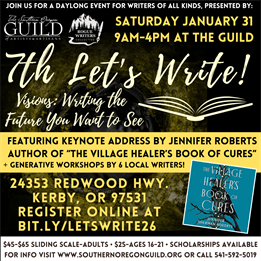
Keynote Address: Southern Oregon Guild of Artists and Artisans and Rogue Writers Collective “Let’s Write” 2026

This keynote address was delivered at the “Let’s Write” conference put on by the Southern Oregon Guild of Artists and Artisans and the Rogue Writers Collective on January 31, 2026.

I was invited in part because of my activism in defending our local library from a termination of its lease. I was asked to talk about that experience and about my writing: I found that combining the two was a little more difficult than I anticipated. Hopefully I made it work (below). You can be the judge of that.

So, what do Shakespeare, Queen Elizabeth I, Josephine Community Libraries, Lin Manuel Miranda, Phillis Wheatley, Thomas Paine, Margaret Cavendish, Mary Wollstonecraft Shelley, Octavia E. Butler, and Ursula K. Le Guin have in common? Read on to find out. (Spoiler: nothing, really, but they’re all in there!)

***

Given that the theme of this year’s writing conference is “Writing the Future You Want to See,” you may be wondering what an author of historical fiction has to offer you. I write about the past, after all, and not just any past—the extremely old and DUSTY past of the 16th and 17th centuries. And believe me, sometimes, when my eyeballs are burning from reading digitized copies of 17th-century handwritten recipes or pamphlets written during the English Civil War with titles like “Fire in the bush: the spirit burning, not consuming, but purging mankinde; Or, The great battell of God Almighty, between Michaell the Seed of Life, and the great red dragon . . . ” (I’ll stop there because it really does go on like that for a while)–that’s when I ask myself the same question: what does this have to do with my world today?

I don’t claim to speak for all historical novelists, but I imagine a fair number of us write about the past for two reasons: 1) it’s cool—I mean, the past is just COOL, sorry, can’t explain it better than that; and 2) we write about the past in order to make sense of our present and envision, perhaps even write into being, the future.

Those two reasons were my motivations for writing The Village Healer’s Book of Cures. I started researching recipes for an academic blog called The Recipes Project, which took medieval and renaissance household recipe books and analyzed the ingredients for medical recipes and recreated culinary recipes. I mean, that’s just objectively cool, right?

 I was giving a talk about these recipes once for Oregon Humanities—I remember it was about a recipe for the Byte of a Mad Dogge (rabies) that called for crabapple that was harvested at night—and an audience member said, wow, that sounds so witchy! And the idea for the novel was born: a woman who used recipes passed down from her foremothers to heal her neighbors who is accused when a Witchfinder General comes to town.

E.L.Doctorow has said “The historian will tell you what happened. The novelist will tell you what it felt like.” In my novel, I wanted my reader to feel the yearning to learn and to understand the world that was felt by my main character, Mary–an opportunity to experiment and learn was an ambition denied most women at the time. I also wanted my readers to imagine what it must be like to be the victim of mob mentality in the witch hunts, to be accused wrongly in a society in which lives—of people, of animals—were often held cheaply.

Both The Village Healer’s Book of Cures and my next novel take place during the English Civil War, a battle over (among other things) the divine right of kings and the natural rights of the people.That sounds like such an ancient debate, doesn’t it, but think about it this way: I’m writing about a time when people are just trying to live their lives while surrounded by  uncertainty and political upheaval, in an era of massive income disparity in which established political norms are going topsy turvy, and everybody is fighting over whether or not we should have a king. Like a nationwide No Kings Rally.

That all sounds pretty familiar, right?

I want my novels to be historically accurate but to speak to the times that we’re in. I want us to wonder: could it happen again? Could certain people, because of their identity, their religion, their interests, become scapegoats, targets of paranoia and hate in this modern world? What in the past has led to this happening and, by extension, what could we do–and how brave must we be–to prevent it happening again?

And I want to be clear that the desire to look to the past to explain the present is not modern. 

For an example, we only need to look to William Shakespeare. In the series of history plays called the Henriad, for example (composed of the plays Richard II, Henry IV parts 1 and 2, and Henry V), Shakespeare traces the monarchy from the tyrannical Richard II—who has divided the kingdom, been abandoned by his allies, deposed, and murdered—to the triumphal Henry V, everybody’s friend Hal, who unites the kingdom, finds a French wife to promote peace with England’s enemy, and has a pivotal victory at Agincourt.  

Shakespeare learned about the reigns of these monarchs from a book called Holinshed’s Chronicles of England, Scotland, and Ireland, starting with events that happened about 200 years before his time. A contemporary example might be Lin Manuel Miranda reading Ron Chernow’s biography of Alexander Hamilton for inspiration for his broadway musical–after all, it was only 200 years ago that Thomas Jefferson and John Adams died (fun fact–they both died the same day–July 4).

Back let’s get back to Shakespeare, who borrowed from Holinshed and boldly reimagined—and in some cases invented from whole cloth—people, places and events in such a way that his audience could see not just the past, but a reflection of their own Elizabethan present.

As I said before, Shakespeare ends the Henriad with Henry V as a model of monarchy, a warrior-king: virile, likable, and quintessentially (according to Shakespeare’s plays) English. But that progression took time, and in order to show the stability of Henry V, a Lancastrian,  Shakespeare had to show the tentative hold that Richard II, from the house of Plantagent, had on his crown.

At this point, I bet you all are thinking one of two things: either “Wow, this is like Game of Thrones! Amazing! Tell me more!”; or, more likely, you’re thinking “Ummm, I didn’t give up my Saturday to sit through a history lesson.” Fair enough.

My point—and I do have one—is this: Shakespeare didn’t consult Holinshed’s Chronicles to write his plays because he wanted to perform a flawlessly accurate view of the past. Indeed, he played fast and loose with the facts. No, Shakespeare used the past to explore what it means to live and believe in and just try to live your life in a monarchy. He used secondary characters, including the famous Falstaff and his tavern buddies, to show what it was like to live as a cog in the monarchy’s wheel, to have your fate determined by the whims of a king. In so doing, he held up the very idea of monarchy to the light, inviting his audience to think not about Richard II or the Henries, but about their current monarch: the Virgin Queen, Elizabeth I.  After all scholars believe Shakespeare wrote the Henriad in order to curry favor with Queen Elizabeth I, a descendant of Henry V, to shore up the strength of her claim to the throne. 

But art is slippery, isn’t it? 

People don’t always interpret things the way we hope they will. When the Earl of Essex commissioned a performance of Richard II to stir up the people before rebellion, Queen Elizabeth–without an heir and increasingly losing allies like Richard II–was suspicious. After Essex’s failed rebellion, Elizabeth is famously quoted as saying, “I am Richard II, know ye not that?” 

It’s an object lesson to us all: we may think we’re writing a thing one way, but the readers can and will read it according to their own thoughts, fears, and ambitions. Soooooo, speaking of ambitious leaders who try to overturn the will of the people . . .

***

At the risk of giving us the bends after that deep dive into history, I’m going to bring us 400 years forward and back from 5,000 miles away, to our own Josephine Community Library.

As writers, I think it’s safe to assume that we all have a deep affection for libraries, and so many of you likely followed the kerfuffle between the Josephine County Board of Commissioners and Josephine Community Library District. 

But here’s an overview, just in case: January 6, 2025, was the last day in office for Commissioner John West and the first day in office for Commissioners Barnett and Smith. 

In the interest of full disclosure, one of the former commissioners has threatened to sue me for defamation for telling people this story, but everything I say can be verified through public record minutes, video, and newspaper stories.

So, on January 6, citing the need to “bring the library to the table,” the commissioners voted to terminate the library’s lease with thirty days’ notice.

The public was outraged and, with a mighty roar that involved protests and letters and phone calls, they let the commissioners know that the library was a precious community resource.

Voting to terminate the lease was bad. Very bad. But what followed was arguably worse: silence. For several months, there was no official action as a result of the vote. The library only learned of the vote because some dedicated volunteers who’d been watching a video of the meeting told them. A critical  meeting was scheduled and then canceled at the very last minute. Quotes were given to media outlets but there was radio silence through official sources.

Finally, in May/June of 2025, Commissioner Barnett was chosen by the board as its official liaison, and he negotiated the lease with library director Kate Lasky. The two hammered out a lease that was agreeable to both parties. Because of what I can only describe as nonsense and tomfoolery from Commissioner Blech, it still took over two months for the lease to be signed.

As the co-chair of the Grants Pass Friends of the Library, it was my (volunteer) job to communicate with members about the state of negotiations. I was also interviewed by media outlets, and this meant countering a lot of faulty memories, gaslighting, and misinformation.

But what has this to do with writing and history, you ask?

Critically, this: the research habits I learned as a writer–tracking dates, quotations, statements, and votes–were invaluable, but even more important was the ability to use the details of what happened in the past to tell the story of what was happening in the present. My training and practice as a writer helped me navigate the consideration of audience and purpose, providing a framework for understanding, in context, what could otherwise be a jumbled pile of bureaucratic paperwork, contradicting statements, and yellowing scraps of newspaper stories.

Storytelling is not limited to writing a novel or a script. Sometimes it’s about the very survival of a beloved public icon.

***

While writing about the past can help us make meaning of the present, I also think our writing can help us imagine, evaluate, and perhaps even bring into being our future.

I’m reminded of a talk I went to by acclaimed scholar James Basker of the Gilder Lehrman Institute: Rhodes Scholar, Harvard and Oxford graduate and, interestingly enough, graduate of Grants Pass High. Several years ago, he visited the high school and gave a lecture to the seniors about two things: 1. applying to college, and 2. his own research into anti-slavery poetry of the Revolutionary Era. I yanked my daughter out of middle school (she was, and is, an avid history buff) and snuck into the PAC at Grants Pass High (don’t tell on me). In his talk, Dr. Basker argued that the poets of the Revolutionary Era–Phillis Wheatley, Thomas Paine, and others–were able, through their expansive imaginations, to write into existence the conditions that led to abolition. They may have written against slavery in their present, but their words created the world that could abolish slavery in the future. 

When discussing futures and other worlds–any science fiction writers in here? Science fiction, to me, seems the natural home of imagining a future–whether utopian or dystopian. From my favorite relatively little-known woman writer of the 17th-century Margaret Cavendish writing about a “Blazing World” with animal scientists that talked; from Mary Wollstonecraft Shelley, who wrote the most sympathetic portrait of a monster I’ve ever read; to Octavia Butler, whose Parable of the Talents and Parable of the Sower are insightful to the point of prophetic.

And then there’s one of the great foremothers of science fiction: Ursula K. Le Guin who, incidentally, once visited Grants Pass library to do a talk with her friend (who was raised in Grants Pass), Roger Dorband. Le Guin wrote The Left Hand of Darkness in 1969, a book in which she famously created an ambisexual world that interrogated the idea of gender; and in The Dispossessed, she explored the tensions between capitalism and anarchy; individualism and community. Gender and social theory are hardly new themes, of course, but by releasing her imagination onto the page, she was able to usher in a world in which our very assumptions about society are held to a higher standard of thought.

The writer Julie Phillips wrote an article about Le Guin last year in Literary Hub called “The Way of Water: On the Quiet Power of Ursula K. Le Guin’s Activism, in which she highlights the most amazing quote. “In 1982, an interviewer . . . asked Le Guin what she would do to save the world. She answered impatiently: “The syntax implies a further clause beginning with if . . . What would I do to save the world if I were omnipotent? But I am not, so the question is trivial. What would I do to save the world if I were a middle-aged middle–class woman? Write novels and worry.”

For my next trick, if you can believe it, I’m going to come full circle and make 14th century and 16th-century England and a 21st-century globalized world meet. A few years before her passing, Le Guin won the prestigious National Book Foundation medal. At her acceptance speech in 2014, in a blistering defense of art over profit, she declared “We live in capitalism. Its power seems inescapable. So did the divine right of kings. Any human power can be resisted and changed by human beings.”

And I think that’s what we writers do–we have the power and the responsibility to change things, to imagine other realities, to unleash our imaginations on the world. In doing so, we entertain, we comment, sometimes we convince–and at our best we always question. And worry. And act. 

But above all–we write.
I hope Ursula K. Le Guin’s paradise is a kind of library

Image may contain: 1 person, indoor

I want to share some memories about one of the coolest nights of my life, when I met and shared a meal with one of my heroes, Ursula K. Le Guin.

I’m not even going to try to be clever in this post (I usually try too hard at that anyway). I’m surprised by how kind of raw I feel about her passing, and I feel like it would be good to share these stories still sharply etched in my mind and heart.

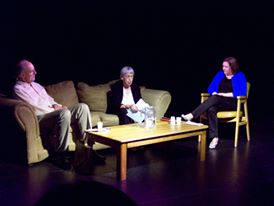
Ursula K. Le Guin came to our small, poor, rural library with her friend Roger Dorband. They had collaborated on the book Out Here:  Poems and Images from Steens Mountain, and they were coming to Grants Pass because it was where Roger had grown up.

I was asked to be the facilitator.

I was terrified.

How do you share a stage with a woman whose writing had consumed you, whose stories had taken up residence in your brain and soul?

How do you do it? Easily. Ursula K. Le Guin was kind, and generous, and warm. She was smart, and funny, and passionate. She loved libraries, and she spoke fervently about the magic and wonder of books and learning.

She made sure any children in the audience (clutching their Catwings books) had extra time with her. She asked them questions and whispered to them that Catwings had been her favorite books to write.

She agreed to go to dinner with several of us who volunteered for the library. I got to sit next to her husband, Charles. He asked me about my children and clapped when I told him my oldest daughter played the cello. So did his, he said humbly (not letting on that she is the accomplished cellist Elisabeth Le Guin, professor of musicology at UCLA and a founding member of the Philharmonia Baroque Orchestra and the Artaria String Quartet). He told me the story of his daughter arranging to have her whole string quartet fly to Portland to play for them because they didn’t feel well enough to travel on airplanes anymore. I think he teared up a bit.

(He and UKLG lit up when talking about their children. It was a joy to see.)

All this, and then Ursula K. Le Guin pretended to lick my husband.

We, the group at dinner, started talking about book signings, and how in some ways it’s kind of a weird phenomenon. “I’ve just given my readers several thousand words. What’s a couple more?” she said. We all agreed a signature was like a souvenir at the atomic level—a sense that the page had touched the ink that had touched the pen that had touched the hand of the writer. It was incarnate, immediate.

Then my husband grinned and said, “Maybe next time, you should just lick the books.”

It was funny, but oh god. I held my breath. I looked at Ursula K. Le Guin–a Library of Congress “Living Legend” and a recipient of awards from PEN and the American Library Association. Winner of multiple Hugo and Nebula awards. A National Book Award winner. A freaking Pulitzer Prize nominee.

What would she think?

She was roaring with laughter.

When dinner was done and it was time to leave, my husband went to shake her hand. She looked at him with a mischievous smile and gave a quick, lizardy lick to the air.

When I went to shake her hand, she instead wrapped me in a hug.

“OMG,” I shrieked after she left the room, “Ursula K. Le Guin hugged me!” I fangirled for days, weeks. Okay, I’m still fangirling.

And I’m not at all embarrassed by my excitement about that moment. Because I am a fan not just of her piercing, evocative, magical writing, or her ground-breaking, deeply human storytelling, but of her.

May she rest in peace.


***

Edited to add: I forgot about this, but about a year later, as we were gearing up to ask voters to approve a library district (we were operating just on donations and grants–long story), our library director asked her to write a letter to the editor. She did. I was stunned, and still am, that she would take the time and energy to write a letter in support of a smallish library system some 300 miles away. Here it is.

To paraphrase Borges, I hope her paradise is a kind of library.

Image may contain: text

Why Do Libraries Bring Out The Best in Us?

A young JCLI volunteer (my daughter!) protesting the library's closure.
A young JCLI volunteer (my daughter!) protesting the library’s closure.

I don’t want to bore you with the story of my local library—I’ve told it a gajillion times. If you haven’t read it, you can do so here or here (I’m quite proud of this library, as you can tell!).

But I will tell you that even after the roller coaster ride of emotions I’ve been on with that crazy, beautiful library, nothing prepared me for the despair I’d feel when, on the morning of February 23, 2016, the Cave Junction branch of the library was vandalized.

It was a slap in the face.

After everything we’d gone through—the work and worry, the tears and triumphs—to have the library torn apart as though it meant nothing? To have the very door of the library—which had become a symbol for our movement, for our single-minded insistence on reopening—smashed into tiny shards of glass?

It was a punch in the gut.

But then something amazing happened.

Word got out about what had happened and we were inundated with offers of help. Our community rallied around us. A local diner, The Powederhorn Cafe, held a “Pi Day” fundraiser (with pie and coffee and proceeds going to the library). Oregon Public Broadcasting covered the story and addressed the lack of law enforcement that might mean nobody would have to answer for the crime. People and businesses donated money for a reward to find the perpetrators. Superhero librarians in other parts of the state offered help and held fundraisers. And good-hearted people from around the country donated money and, more importantly, sent their kind words and support.

The library was insured, of course, but on our shoestring budget, even a $5,000 deductible is a big chunk of change. With all of the support and donations, our library met that goal and topped it, raising over $11,000.

I felt like the Grinch, but in a good way. My heart grew by three sizes that week.

And I began wondering: what is it about libraries that brings out the best in us?

I think the very idea of a library assumes that people are basically honest. If a person borrows a book (or magazine, or CD, or DVD), they will bring it back for somebody else to use. Sure, some people will bring back materials late (lord knows I’m one of the worst offenders here—I could probably fund a full day of operation on my overdue fines alone). They may even abuse the system by stealing books (but those people are few and far between). But at its very core, the library assumes a social contract, an ethos of paying it forward.

Libraries exist because we want to share the hard work of the mind, the growth and expansion that comes from deep thought and wide experience. We want to hand over new discoveries that can be enhanced by diverse perspectives, and we want to hand down knowledge to the next generation so that we and they can benefit. Together.

These words feel small and paltry when compared to the potential of the library. This short movie based on the wonderful book The Fantastic Flying Books of Mr. Morris Lessmore, on the other hand, says far more eloquently what I wish to say…and it says it with no words at all.

Trolling Librarians Are The Best Librarians

Hacking’s a terrible thing. Terrible.

Except when it isn’t. Like when this guy pretended to be a Target sales rep and trolled people opposed to Target’s new gender-neutral toy marketing policy.

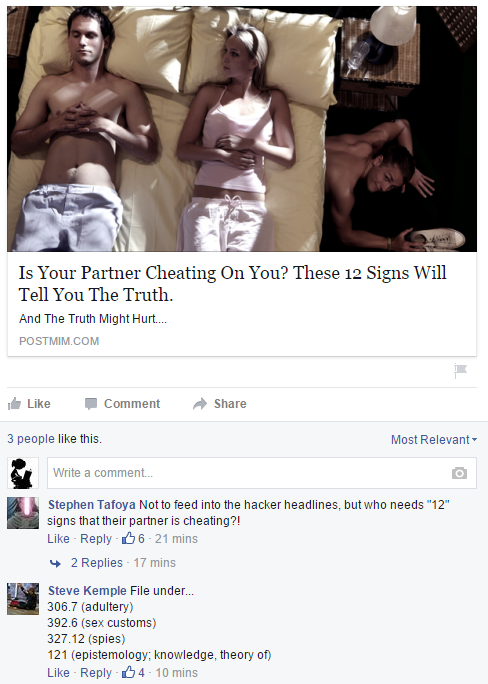
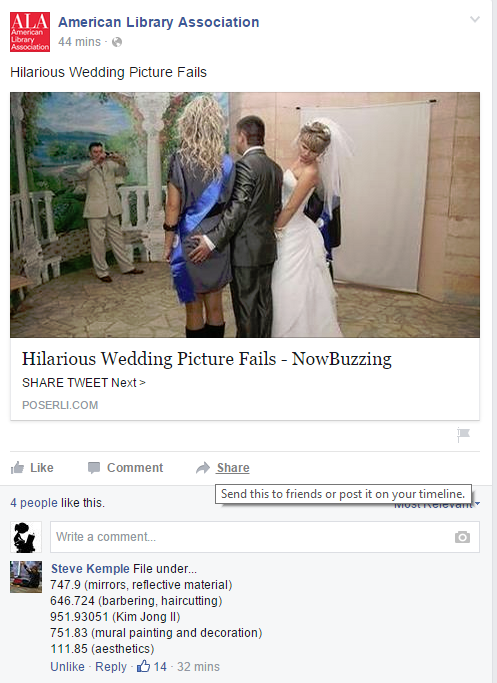
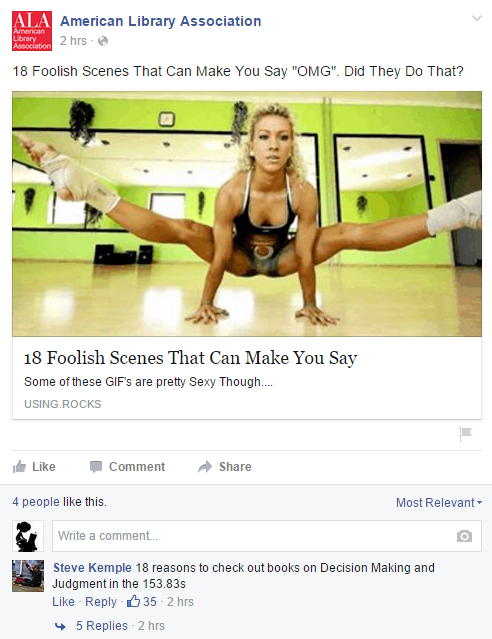
Or like when the American Library Association got its Facebook account hacked a few hours ago and librarians got all funny and beautifully weird and trolled the hackers, like in the screen shots I captured below.

Did I mention I freaking love librarian humor? These people are the salt of the earth.

ala2

Librarians are very discreet:

ALA3

Did you know your library records are always kept private?:

ALA5

Librarians can guide you to examples of words like “misogyny” (ya know, if you’re a visual learner):

ALA7

No, but really, some good advice from Stephen and Steve here:

ALA6

Libraries Matter, No Matter What

A young JCLI volunteer (my daughter!) protesting the library's closure.
A young JCLI volunteer (my daughter!) protesting the library’s closure.

In May 2007, all four branches of the library in Josephine County were closed due to lack of funding. More than 82,000 people were left without access to any library whatsoever.

(Over eight years later, I still feel a little shocked writing that.)

A past library levy had been absorbed into the county’s general fund. When the federal government failed to renew a decades-old subsidy (meant to reimburse county governments for the loss of income from logging on federal lands) and voters (mistrustful of county government) failed to pass a measure establishing an independent library district, the libraries were closed.

I was there, and I was devastated. I kept thinking about how a whole generation of kids would grow up receiving the message–from their own community–that books, literacy, and knowledge don’t matter. That learning about the world outside their borders doesn’t matter. That libraries don’t matter.

In August 2007, a group of concerned citizens banded together to form Josephine Community Libraries, Inc. (JCLI), and after 18 months of fundraising—stuffing envelopes, staffing information tables, and begging councilors and commissioners for money—volunteers reopened the Grants Pass branch of the library. Committed to providing library services throughout the county, the board of directors made it a priority to reopen the other three rural branches as soon as possible after the opening of the main branch.

I’ll never forget the opening of the Children’s Room on that cold December day in 2008. I was standing at the circulation desk so I could take pictures. On the other side of the ceremonial ribbon stood crowds of excited and curious kids. When the ribbon was cut, the kids streamed into the room. When it came time to check out, they had stacks of books in their arms and magic in their eyes.

On that day, we sent a message to the kids in our community: we care. We care about their education and imagination. We care that they have a future in the larger world.

Last fall, citizens placed a library district on the ballot in Josephine County that would have provided long-term, sustainable funding for libraries in Josephine County. Sadly, it didn’t pass. If it had, renovating the Children’s Room would have been one of the first priorities.

However, despite our disappointment in the results of the election, JCLI remains determined to provide quality library access for the children in our community by launching First Chapters, a project to modernize and enhance the Children’s Libraries in Grants Pass and Cave Junction.

The project will fund updated books, mobile bookshelves kids can reach, and furniture that actually fits them. It will provide technology that matches their need to learn and resources that fit their need to play.

Just one of the many books that needs replacing.

JCLI has also partnered with Oregon’s Kitchen Table, a group of non-partisan, non-profit community organizations that is helping JCLI with crowdfunding, so that as many people as possible can donate to the project, to feel ownership of the amazing work libraries are doing in our community. If you’d like to help out, you can make a donation here.

First Chapters

By reopening the libraries, we transformed the message we were sending to our kids. Instead of telling them that books, knowledge, and culture are expendable, we taught them the importance of lifelong learning and connection with community and the outside world. With First Chapters, we can reinforce that message. We can teach them that libraries matter, no matter what.

Libraries Matter, No Matter What

I’m really sad.

LibraryCardHandsFor the last seven years, I’ve been volunteering with Josephine Community Libraries, an amazing group of folks who’ve worked with persistence and dedication to reopen our libraries after they were closed due to lack of funding (leaving 82,000 people without access to any library services whatsoever).

This year, some of us formed a political action committee to put a library district on the ballot. The district would have been completely independent of the government entities that closed the library in the first place.

On Tuesday, my community voted no on libraries. This is my response:

***

This is a hard blog post to write.

A majority of voters in Josephine County said “no” to a library district. They said no to investing in our community, to providing a safe place to learn and grow for our children, to ensuring that we always have a place where, regardless of income, we can improve ourselves.

It’s a bitter pill to swallow.

If you’re a supporter of the libraries, you may be having a hard time deciding what to do next. You’re probably shaking your head, wondering how our county can fail to see that libraries are foundational, that they transform lives daily. Maybe you’re embarrassed to tell family and friends in other parts of the country that you live in a place that won’t fund libraries.

And maybe you feel resentful of volunteering or writing a check to keep the libraries open, feeling as though you are subsidizing a vital community service for the naysayers.

I get it. I really, really get it. I’ve been struggling with those feelings for the last seven years, ever since we began working on reopening the libraries.

But then I remember the election of 2006. I was at the library campaign party when the results were called, and I was busy talking. I turned around to check on my kids, and I saw that my daughter, six years old at the time, was bawling. Just sobbing.

I was taken aback when I learned that the next chance to vote on a library district might not be for another four or five years. My oldest daughter would be eleven. My youngest would be nine. Those are critical reading years. And then I thought of all of their classmates and friends. A whole generation of kids who would grow up without the wealth of information and imagination a library provides…and a generation that would learn a harsh (and false) lesson that libraries, literacy, and education are worthless.

Then I remember the 15,474 people who voted yes. And the over 300 volunteers who give so tirelessly of their time and talent. And the 2,300 people who donate generously, knowing that libraries cost money, that they can’t just operate with a bunch of books and a card catalog.

Many have commented on the dedication of our volunteers and donors. It’s not just a fluke. That tenaciousness arises from the conviction that libraries matter.

Without a library district, drastic changes will need to be made. JCLI simply cannot afford to continue providing the current level of service with current revenue.

I know these changes have to happen, that our libraries will get worse, not better. Sometimes I feel paralyzed by the financial burdens the library faces.  But I try to remember that small actions add up to great accomplishments, and when I volunteer or write out my check, I imagine my contribution helping JCLI provide better library services for even one additional day. That’s one day that thousands of Josephine County children have access to all the books they can imagine. That job seekers can fill out applications online. That seniors can have large-print books delivered to their home. That people of all ages, incomes, and backgrounds can transform their lives.

And it’s one more chance to send the message—to our children and to the outside world—that we care about ideas, education, literacy, and culture.

To find out more, click here.

Today’s Libraries: Something for Everyone (But Maybe Not A Swimming Pool)

In 2007, all of the libraries in my county were closed due to lack of funding, leaving 82,000 people without access to any library services whatsoever.

It sucked. A lot. For so, so many reasons.

Since then, I’ve been a volunteer for Josephine Community Libraries, a nonprofit that reopened the libraries when the county government refused to do so. A group of us have also formed Keep Our Libraries Open, working to pass a publicly funded library district in Josephine County.

Anyway, that’s the background to this piece I wrote for Keep Our Libraries Open.

****
Back in 2009, when JCLI finally reopened the library, we volunteers worried we were in over our heads. After 18 months of working together, we sure knew how to fundraise, but we didn’t know yet know how to run a library. One thing was a given, though: this library would reflect our community’s needs. So we set out a suggestion box.

The ideas we got were pretty much what we expected: materials requests, questions about expanded hours, new program proposals.

We didn’t expect this: Read more...

Of Milton, Genesis, and Sherman Alexie’s The Absolutely True Diary of a Part-Time Indian

For five years, I’ve been attending meetings of my public school district’s curriculum council. Five years of reviewing testing data, kindergarten schedules, and proposed changes in nutrition guidelines–all sorts of drudgery.  Nothing terribly interesting ever happened.

Well, I missed last month’s meeting, and that’s when it all went down. The council decided to recommend that the school board remove Sherman Alexie’s Absolutely True Diary of a Part-Time Indian from the high school curriculum.

(Note: time for a major mea culpa. I could have voted on the issue over e-mail but I forgot to do so. I realize that was a pretty sucky thing to have forgotten.)

We had discussed other books in other years—Cormac McCarthy’s The Road, most notably—but the most draconian the council had ever gotten was to approve a text with restrictions, which I could live with.  But this time, they voted to remove the text from the curriculum altogether (and yes, I’m still kicking myself for missing the blasted vote).

I greatly respect the other parents on the curriculum council. I truly believe that, to a person, they are doing what they think is right for their children and for our district.  However, I couldn’t disagree more with the decision that was reached.

According to notes from the meeting and an article in the newspaper, reasons given for the removal of Alexie’s book included violence, profanity, and sexual content. Objections were also made to the alcohol consumption in the book.

But the thing is, violence, profanity, and sexual content are laced throughout the entire literary corpus. Indeed, based on those objections, I don’t see how the district can justify the inclusion of the Bible (which is used in a bible-as-literature class) or any of Shakespeare’s tragedies in the curriculum. Consider:

  • Objections to discussion of masturbation in Absolutely True Story of a Part-Time Indian:

How is the story of Judah’s son Onan in the first book of the Bible that different? Judeo-Christian exegesis often considered this story to be an injunction against masturbation and any “spilling of seed” whatsoever (from whence we get the word “onanism”).

“Judah said unto Onan, Go in unto thy brother’s wife, and marry her, and raise up seed to thy brother.  And Onan knew that the seed should not be his; and it came to pass, when he went in unto his brother’s wife, that he spilled it on the ground, lest that he should give seed to his brother. And the thing which he did displeased the LORD: wherefore he slew him” (Gen. 38:8-11)

  • Objections to violence:

In Shakespeare’s Macbeth, Lady Macbeth urges her husband to murder Duncan using the language of infanticide.

I have given suck, and know
How tender ’tis to love the babe that milks me:
I would, while it was smiling in my face,
Have pluck’d my nipple from his boneless gums,
And dash’d the brains out, had I so sworn as you
Have done to this.

(I.vii.54-59)

Is that better than the description of a school fight?

  • Objections to the consumption of alcohol

Consider Gen. 9: 20-23, in which Noah becomes so drunk that he passes out naked.

“And Noah began to be an husbandman, and he planted a vineyard: And he drank of the wine, and was drunken; and he was uncovered within his tent. And Ham, the father of Canaan, saw the nakedness of his father, and told his two brethren without. And Shem and Japheth took a garment, and laid it upon both their shoulders, and went backward, and covered the nakedness of their father; and their faces were backward, and they saw not their father’s nakedness. And Noah awoke from his wine, and knew what his younger son had done unto him.” (Gen. 9: 20-23)

  • Objections to sexual and violent content:

Consider Hamlet’s decision to wait until his uncle Claudius is no longer at prayer to kill him because if he waits until his uncle is drunk or has just had sex with Hamlet’s mother, Claudius will go straight to hell:

“and know thou a more horrid hent:
When he is drunk asleep, or in his rage,
Or in the incestuous pleasure of his bed;
At gaming, swearing, or about some act
That has no relish of salvation in’t;
Then trip him, that his heels may kick at heaven,
And that his soul may be as damn’d and black
As hell, whereto it goes.” (Act 3, Scene 3, 88-95)

But, of course, I would never argue that Hamlet, Macbeth, or the Bible should be banned. Nor should The Absolutely True Story of a Part-Time Indian. These are all works that engage the mind and the conscience, asking us to grapple with preconceived ideas and imagine new possibilities.

In his pamphlet Aeropagitica, John Milton argued against pre-publication censorship of writing.  For Milton, a mind that has read widely and had unfettered access to all manner of thought is a mind that is trained to discern true things:

“Let [Truth] and Falsehood grapple; who ever knew Truth put to the worse in a free and open encounter? Her confuting is the best and surest suppressing.”

Our students should have the freedom to read an discuss difficult ideas in the safety of a classroom with the support of a well-trained teacher.

Or, as Milton put it, “Give me the liberty to know, to utter, and to argue freely according to conscience, above all liberties.”

*******

Update: 9/22/14

The matter was put before the members of the Grants Pass School Board, who requested that the issue be tabled for one month so they could read the book. At the next meeting, they voted to approved Sherman Alexie’s The Absolutely True Diary of a Part-Time Indian. 

You guys, I am so proud of my school board for insisting they be given a chance to read the book before taking action, and I’m absolutely thrilled that they voted to keep it.

Ex libris

“King Charles I at the Bodleian Library,” by William Gale

I believe that most people (or at least the people I want to know) have a special “library place” in their hearts. It’s what causes the smile that breaks when entering a new library; the shiver on catching the familiar whiff of old books; the frisson of anticipation after realizing that stacks and stacks of books can be taken home and savored.

Libraries have been a big part of my life for the last five years.  In 2007, my community’s library was closed for lack of funds, leaving 82,000 American citizens without access to any public library whatsoever.  Unthinkable, right?

Long story short: a group of very cool folks got together and fundraised and fundraised some more and re-opened the library as a nonprofit.  There are hopes that we can pass a library district in the near future so that the library is again sustainably funded, but in the meantime we all work like crazy to keep the doors open (more here: www.josephinelibrary.org).

So last year, when I planned my first solo trip to England—sans husband and kids, free to direct my steps wherever I wanted without worrying about potty breaks, snacks, or pending soccer matches—it was only natural that at the top of my must-visit-or-else-what-the-hell’s-the-point-of-going list was Oxford’s storied and magnificent Bodleian Library.

The Bodleian, built in 1320, was Oxford’s first university library (meaning it wasn’t attached to one specific college). That original library, smallish and uninspiring, expanded when Humfrey, Duke of Gloucester, donated over 200 valuable manuscripts in the 1440s, so the university constructed a new room over the Divinity School. (Harry Potter fans: note that the hospital wing scenes with Madame Pomfrey were filmed in the Divinity School, and all of the Hogwarts library scenes were filmed in Duke Humfrey’s library.)

Duke Humfrey’s library, finished in the 1480s, lasted about 60 years until, under legislation passed under King Edward VI meant “to purge the English church of all traces of Roman Catholicism,” the library was stripped of all books and manuscripts containing “superstitious books and images.”  (Why do I include this in my short history of the Bodleian?:  it is perversely of some comfort to me to know that my town’s library is not the only victim of shortsighted thinking on the part of autocratic politicians.)

The Bodleian was resuscitated in 1598 by an injection of funds from Sir Thomas Bodley, after whom it was renamed. Bodley established three guidelines that have shaped the Bodleian’s character:

1)      He established an agreement with the Stationers’ Company of London that would direct the mission of the Bodleian to this day: a copy of every book registered with the Stationers’ Company was to also be deposited at the Bodleian. This agreement transformed it into a critically important repository of learning in England for the next four centuries.

2)      He determined that scholars from all universities should have unfettered access to the holdings of his library, a generous and liberal policy that allowed the Bodleian to transcend the relatively parochial constraints of English scholarship. (While all scholars were welcome, however, they all had to swear the following oath: “I hereby undertake not to remove from the Library, or to mark, deface, or injure in any way, any volume, document, or other object belonging to it or in its custody; nor to bring into the Library or kindle therein any fire or flame, and not to smoke in the Library; and I promise to obey all rules of the Library.” I know this because I couldn’t resist buying the tea towel with the oath printed on it.)

3)      He ordained that no books were to leave the building. No borrowing of books or materials, period.  This policy is in place to this day for the majority of the collection.

I find this last policy fascinating, because in the early days of my library’s resurrection, we faced a critical decision: invest in the (rather expensive) software that would allow us to circulate books or just house the collection for patrons to view in the library. A very sage and experienced librarian decided the point by declaring that if books and materials didn’t circulate, we would have a reading room, not a proper library. If we agree with that definition (and I do), the the Bodleian, one of the most famous libraries in the world, is technically a reading room.

Even King Charles I, facing a mutinous parliament in London and escaping to the relative security of Oxford in 1642, was denied borrowing privileges at the Bodleian (though in order to appease His Majesty, the librarians had a little stall built inside Duke Humfrey’s Library so the King could taste the fruits of scholarship in privacy). By the doctrine of the divine right of kings, this was the man who was, in Shakespeare’s words, “the figure of God’s majesty/His captain, steward, deputy-elect,” and yet even he was denied check-out privileges.

After my tour of the Bodleian, marveling at the majesty of most influential books and manuscripts in history, I stopped by a pub (as I am wont to do). It occurred to me, as I re-acclimated to the noise and smell and colors of everyday life, that the American library tradition–begun by Benjamin Franklin and brought to fruition by Andrew Carnegie and countless American communities–of enabling every citizen to have free and unfettered access to information is one of the most radical movements in history.

In Oxford, at the Bodleian, I could gaze at magnificent books chained to the shelves, marvel at the scholarship contained in the august buildings, and admire the history of the furniture, the paintings, the architecture.  But in little Grants Pass, Oregon, I could walk into my community’s library and check out almost any book in the building.

In this, I am richer than kings.